
Luck Is Not Random: What Leaders Get Wrong About Opportunity
Updated: Mar 25
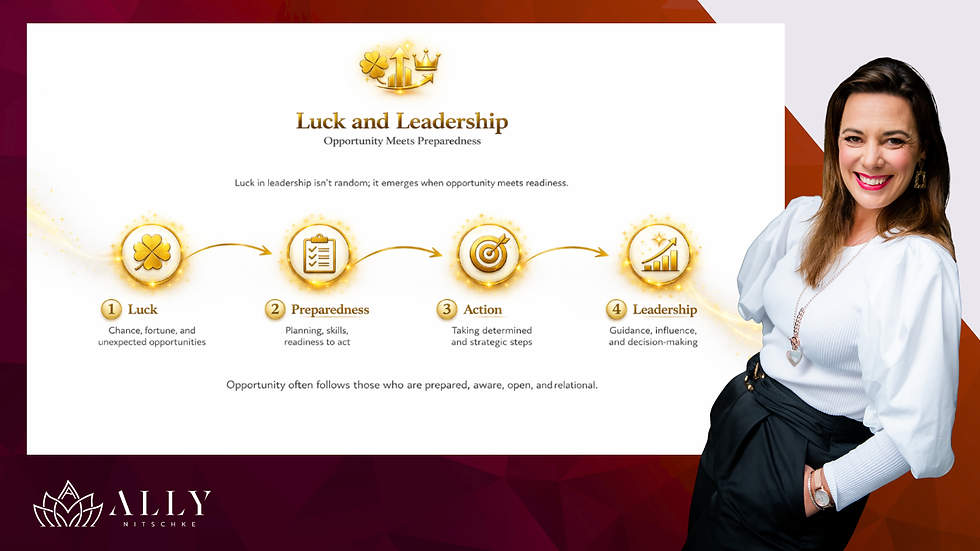
There is a phrase high-performing people hear all the time:
“You’re so lucky.”
It is usually said with admiration. Sometimes with envy. Occasionally with a quiet assumption that things just worked out.
But most leaders know that success rarely “just happens”.
Behind the promotion, the keynote, the breakthrough, the invitation, or the big opportunity, there is usually a stack of unseen effort. Preparation. Repetition. Setbacks. Courage. Positioning. Persistence.
Which raises an important question:
Is it really luck, or are we mislabelling readiness?
Why leaders often resist the idea of luck
Many ambitious leaders do not like the word luck because it feels like it minimises effort.
If you have worked hard, sacrificed, stretched, and built your capability over years, being told you are “lucky” can feel like someone has skipped over the entire story.
And yet, luck does play a role in leadership.
Not in the simplistic sense of magic or chance, but in the more practical sense of opportunity meeting someone who is ready to act.
That is where luck becomes interesting.
Because the leaders who appear lucky are often the ones who have quietly built the habits, mindset, and relationships that make opportunity more likely.
What luck actually looks like in leadership
Luck in leadership is rarely random.
It often looks like this:
saying yes to a room you almost talked yourself out of entering
following a thread of curiosity that leads somewhere important
building relationships before you need them
taking on a project that stretches you
staying open when others become rigid
spotting an opportunity that others dismiss as inconvenient
being prepared enough to act quickly when the moment arrives
From the outside, that can look like “perfect timing”.
From the inside, it usually looks like readiness.
The dancer’s lesson: what people call luck is often grunt
As a dancer, I was often told I was lucky.
Lucky to win. Lucky to perform lead roles. Lucky to have certain opportunities.
But what people did not see was the endless rehearsal behind the result. The corrections. The sore feet. The repetition. The discipline. The hundreds of unseen hours spent refining one movement until it became instinctive.
That was not luck.
That was grunt.
Leadership works the same way. People often call someone lucky when they did not witness the preparation that made the opportunity meaningful.
They see the result, not the rehearsal.
Four ways leaders can create more luck
1. Put yourself where opportunity lives
You cannot build a lucky career from the sidelines.
The more visible, engaged, and connected you are, the more likely you are to encounter new ideas, conversations, and openings. Attend the event. Join the discussion. Put your hand up. Expand your circles.
Opportunity needs somewhere to find you.
2. Stay open when things feel uncertain
Some of the best leadership opportunities arrive dressed as discomfort.
A stretch role. A hard conversation. A messy challenge. A problem no one else wants.
Leaders with a growth mindset are more likely to move towards those moments, and in doing so, they often create the very breakthroughs others later describe as lucky.
3. Lead with curiosity
Curious leaders notice more.
They ask questions, explore perspectives, and remain open to what they do not yet know. That openness helps them spot possibilities others miss.
Curiosity widens your field of vision, and that matters in leadership.
4. Invest in relationships
Luck often moves through people.
A recommendation. An introduction. A passing conversation. A trusted relationship that opens a door at exactly the right moment.
The strongest leaders do not build networks transactionally. They build real relationships over time, and those relationships often become the pathway through which opportunity arrives.
The real leadership advantage
The leaders who create more “luck” are not necessarily the smartest, loudest, or most naturally gifted.
They are often the ones who are:
prepared
aware
visible
open
relational
willing to act
That is the real advantage.
Not blind optimism. Not magical thinking. Just a leadership approach that combines effort with openness and discipline with possibility.
My 2 Cents Worth
Luck is not a substitute for hard work.
But hard work alone is not always enough.
At some point, leadership also asks you to stay open. To notice. To move. To trust your preparation enough to walk through the door when it opens.
So the next time you catch yourself saying someone else is lucky, pause for a moment.
You may be looking at the result of years of unseen work, plus the courage to recognise an opportunity when it appeared.
And that is a very different kind of luck.
If you would like to book in a time to speak with Ally: CLICK HERE.
Ally Nitschke is a best-selling Author, an award-winning Thought Leader and Speaker. She has been working with leaders and as a Leader for over 20 years.
She is on a mission to change the way we communicate at work, to lean into those uncomfortable conversations and lead with courage.
Ally is a Keynote Speaker at conferences, delivers Transformational Programs & highly engaging workshops as well as provides Executive Coaching.


Comments