
Calm Is a Leadership Signal
I've been thinking a lot lately about how leaders are showing up right now.
Recently I've found myself the chair of P&F (parent committee) at school. And the role kicked off with one of the major events of the year - Mothers Day. It was a whirlwind couple of days, on the back of a whirlwind 3 weeks of pulling this event together.
During the final event, the mother's day stall, a few volunteers conmented how calm I seemed. I joked, that if I'd been wearing a heart rate monitor for the last few weeks it would tell a different story.This isn't the first time someone has said this to me. Whist I feel stressed, nervous, under pressure on the insiode. The outside tells a different story.
I think it's because I know that under pressure, leaders become the weather system in the room.
Before you've even said a word, your team is already reading the signal. Your pace, your tone, the tensions, the sharp reply, a rushed decision. The silence that sometimes feels steady, and the other silence taht feels dangerous.
Whether you realise it or not, people calibrate around the person leading the room.
That's why being able to be calm is not a soft skil, it's a leadership signal.
In complex and high-pressure environments, it can be the difference between a team that reacts and a team that responds.
Calm Is Not Passive, It Is Communicative
Calm is often misunderstood, Some people hear calm and think it means slow, soft, disengaged or lack urgency. But real calm is anything but passive.
Calm is deeply communicative.
When a leader remains steady under pressure, they're signalling "we can handle this." When you respond thoughtfully instead of reactively, you're signalling "we can think clearly here."
When leaders don't add panic to pressure, they create space for others to stay connected, capable and constructive.
Calm doesn't mean nothings wrong. It measures the leader isn't making the wrongness louder.
In environments where uncertainty is high, that kind of calm becomes a leadership language of its own.
Teams Take Their Cue From the Leader
As human beings were exquisitely attuned to the behaviours of the person leading the room. Teams notice everything.
Your team will notice your tone, your pace (word count per minute), if you have tension in your jaw, the sharpness in your reply. They'll notice when you're trying to look composed, but your body is telling a completely different story.
And often, without conscious awareness, your team will calibrate themselves accordingly.
When you escalate, your team will escalate, when you rush, your people will start rushing (even when speed isn't the answer).
But, when you stay regulated, something different happens. People breathe a little deeper, conversations slowdown enough for sense-making, thinking expands, and the room can access its human intelligence again. (Phew!)
This is not accidental. It is biological.
The Cost of Unregulated Leadership
A trap I see leaders falling into, is that many don't realise they're broadcasting pressure. They think they're being efficient, direct or decisive (because good leaders make decisions!) What they don't realise their team's experience is that they can come across sharp, rushed, unpredictable, or unsafe... and dare I say, bossy.
Overtime, that corrodes relationships, people begin to hesitate, they might self edit (or withdraw), they'll avoid the hard (but necessary) conversations. They'll wait for permission instead of taking accountability and initiative. They'll stop contributing.
This is where leadership presence stops being a nice idea, and becomes a performance issues. Because the way you hold pressure, directly affects how your team thinks, speaks, decides and recovers and celebrates.
The Three Layers of Calm Leadership
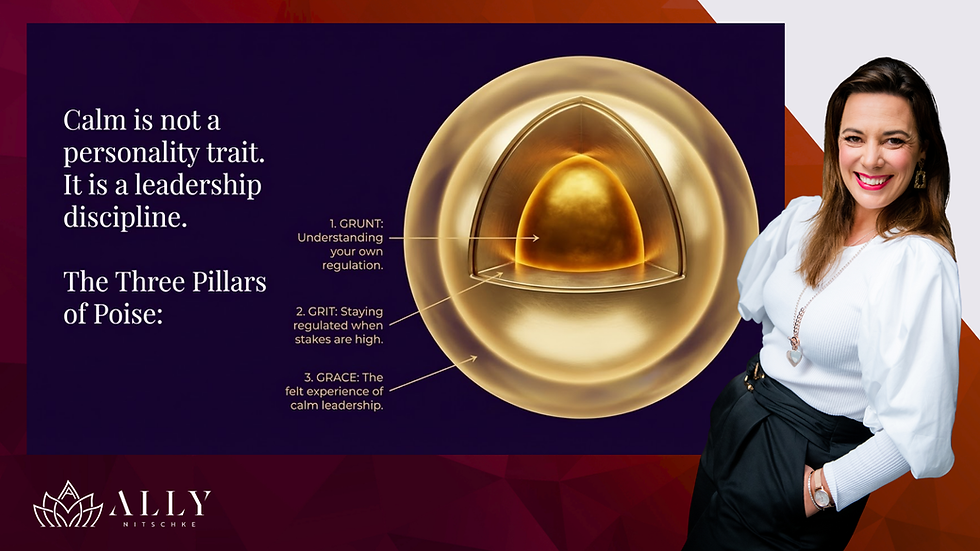
In my work with leaders and teams, I often describe leadership in modern complexity through three layers.
Grunt, Grit and Grace
This is not just an idea, but rather a practical leadership discipline.
Grunt: Understanding Your Own Regulation
Calm begins with self-awareness.
Not the fluffy kind, the honest (uncomfortable, knees weak, arms spaghetti) kind.
The kind where you know what pressure does to you before it starts leaking into the room. Perhaps your breath gets shorter, your thinking narrows, you might start becoming more controlling, more abrupt, more avoidant or performative.
Building that awareness doens't happen by accident. It's built through reflection (the most under-utilised tool in modern leadership), it's build through practice, feedback and willingness to face upto your own patterns.
This is the Grunt work of leadership. Because without that awareness, calm is just a performance.
Grit: Staying Regulated When It Would Be Easier Not To
It's easy to be calm when everything is going well. it's much harder when the stakes are high, the deadline is looming, emotions are loud and everyone is looking to you for certainty (that you may not have yet).
That's where grit comes it. Grit is the ability to stay with discomfort without transmitting it.
It's the discipline of holding your own nervous system steady when everyone elses is asking you to join the spiral (don't give into peer pressure!)
I'm not saying suppress what you feel, and I'm definitely not saying pretend you're fine when you're not. What I'm saying is; learn to contain your response for long enough to choose it. Preferrable choose a helpful response.
Leaders that display grit don't deny reality, they simply refuse to amplify the chaos. And that matters more as a leader than you might realise.
Grace: The Signal Others Feel
Grace is the felt experience of calm leadership.
It's the leader who doesn't rush to fill every silence (if you've attended our Executive Presence workshop you'll remember the 30second rule!). It's the leaders who listens fully before responding (or preparing to respond while listening). Grace is the decision maker who can creates clarity without creating panic.
Grace signals safety.
When people feel safe, they think better, they speak more honestly, they collaborate more effectively, they take responsibility instead of deflecting it.
Grace is not a technique, it's what people experience when regulation has been practiced over time.
Why Calm Builds Trust Faster Than Confidence
Confidence can be impressive. In my experience most people want more of it.
Calm on the other hand is trustworthy. What would happen if your focus was on calm rather than confidence.
In moments of pressure, your team aren't just listening to what you say, they're asking themselves, 'can I trust them with this moment?'. Calm leaders feel anchored, predictable and reliable. They still have conviction, but their conviction is not fulled by anxiety.
Calm Is a Strategic Leadership Choice
In complex environments, which is where we find ourselves today, Leaders can't afford to become the loudest emotional signal in the room. There's enough noise already.
Calm creates space for better decisions, more honest conversations and room for stronger focus (not to mention it feels better for everyone ).
When you're calm, it gives people time to think instead of react.
Calm is a leadership discipline, and like all disciplines, it becomes more available when you work on it before you need it.
The Invitation for Calm
If you want to increase your influence, pay attention to the signals you're sending.
Not just through what you say, but through how you're showing up. How you enter the room, how you respond to pressure, how you hold tension, how (well) you listen when things get uncomfortable, how you steady yourself before you try to steady everyone else.
Calm isn't necessarily about slowing everything down, it's about steadying what matters.
And for leadership team navigating pressure, change or complexity that steadiness can change the entire room.
These are the practical ideas I bring into keynotes and workshops, helping leaders regulate under pressure, communicate with clarity, and create the conditions for stronger trust, better thinking and more honest (courageous) conversations.
If you would like to book in a time to speak with Ally: CLICK HERE.
Ally Nitschke is a best-selling Author, an award-winning Thought Leader and Speaker. She has been working with leaders and as a Leader for over 20 years.
She is on a mission to change the way we communicate at work, to lean into those uncomfortable conversations and lead with courage.
Ally is a Keynote Speaker at conferences, delivers Transformational Programs & highly engaging workshops as well as provides Executive Coaching.


Comments